
初恋这件小事
Levee breach sealed in China's flood-hit Henan_我的网站

A | A levee breach in central China's Henan Province was successfully sealed on Friday night after nearly two days of emergency repair work, local authorities said.
The breach, measuring more than 40 meters wide, occurred along the Beiru River in Jiaxian County, Pingdingshan City, on Wednesday night after heavy rainfall caused a section of the levee to give way, forcing the relocation of more than 2,000 people.
No casualties have been reported so far.
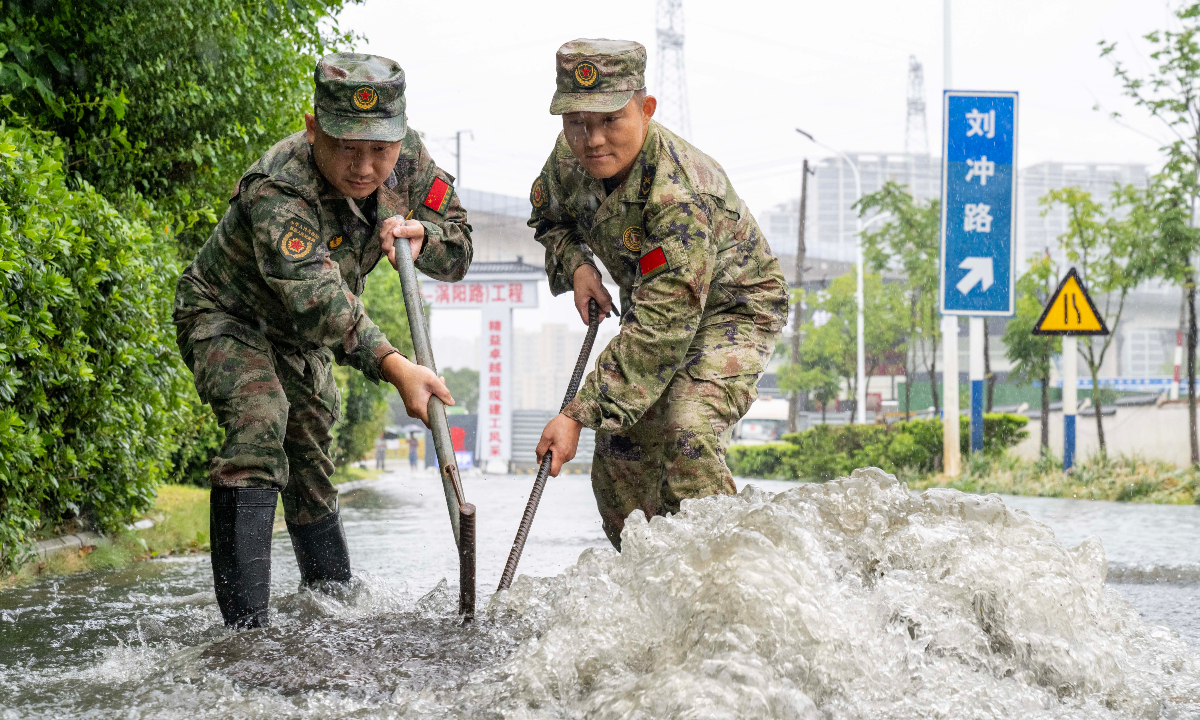
Due to the narrow road atop the levee, heavy construction vehicles were unable to reach the site. Rescue workers formed human chains to pass gravel-filled sandbags to the breach, while drones and rescue boats were deployed to transport materials.
The operation came amid widespread flooding triggered by heavy rainfall brought by the remnants of Typhoon Dolphin, the year's 13th typhoon, which has affected multiple parts of Henan Province in recent days.
In response, the National Commission for Disaster Prevention, Reduction and Relief activated a Level-IV national disaster relief emergency response for Henan on Friday. The central government has allocated 30,000 items of relief supplies, including folding beds, summer quilts and family emergency kits, to support relief and resettlement efforts in Zhoukou, Xuchang and other affected areas.
。
Typhoon Dolphin stopped being numbered at 5 pm on Tuesday, however its impacts continue as it triggered strong winds and heavy rainfall in inland areas as far north as Beijing. The National Meteorological Center (NMC) issued an orange alert for heavy rain, along with blue alerts for severe convective weather. Some areas are expected to see rainfall of 250 to 300 millimeters, CCTV News reported on Tuesday.
The China Meteorological Administration maintained a Level II emergency response on Tuesday as Typhoon Dolphin, its remnants, and cold air were forecast to bring heavy rain to parts of eastern and northern China including Zhejiang, Jiangsu, Anhui, Hubei, Henan, Shandong, Shanxi, Hebei and Beijing over the next three days, CCTV reported.
From Tuesday morning to Wednesday morning, parts of multiple regions including western Jiangsu, north-central Anhui, Henan, central and western Hubei, western and southern Hebei, Beijing, central and western Inner Mongolia, northwestern Heilongjiang, and southwestern Yunnan are expected to experience heavy to torrential rainfall. Some areas in central Henan could see extreme rainfall, with accumulated precipitation reaching 250 to 300 millimeters, according to CCTV.
Beijing activated a Level II flood-control emergency response at 9 am on Tuesday, with authorities at all levels throughout the city mobilizing flood prevention measures, CCTV reported. Meanwhile, the Ministry of Natural Resources launched a Level IV geological disaster defense response for Beijing at 3 pm on Tuesday.
According to the Beijing Meteorological Service's forecast, from Tuesday evening through Thursday, most parts of Beijing will experience heavy rainfall, with accumulated precipitation expected to exceed 100 millimeters in six hours and 150 millimeters in 24 hours.
In seven areas including Tongzhou, Daxing, Fangshan, Mentougou, the Beijing Economic-Technological Development Area, Huairou, and Fengtai, six-hour rainfall totals could exceed 150 millimeters, while 24-hour accumulations could surpass 200 millimeters, CCTV reported.
Beijing receives an average of 528 millimeters of precipitation annually, with most of it typically concentrated between June and September. Therefore the rainfall in 24 hours since Tuesday evening would likely be equivalent to more than one-third of the city's annual rainfall.
Beijing's flood control authorities ordered personnel responsible for urban waterlogging hotspots to take their posts from noon on Tuesday, with drainage equipment and flood barriers pre-positioned.
The city's flood control authorities also ordered the evacuation of people in flood- and landslide-prone areas before 6 pm on Tuesday and required work at construction sites to be suspended and mountain campsites and related tourist attractions to be closed.
Starting Wednesday, Beijing will encourage flexible work arrangements and staggered commuting, while schools may suspend classes and offline training, as well as outdoor teaching activities. Outdoor sports events will be halted, traffic controls imposed in high-risk areas, and public transport adjusted according to weather conditions and safety needs, CCTV reported.
As significant rainfall is expected to begin affecting western and southern parts of Shandong Province on Tuesday, Jinan city has taken precautionary measures in advance, with multiple large and medium-sized reservoirs carrying out controlled pre-releases to create additional flood-control capacity and prepare for rainfall brought by the typhoon, CCTV reported.
In Henan Province, the provincial department of water resources and provincial meteorological service jointly issued a red alert for flash floods at 8 am. It is forecast that from 8 am Tuesday to 8 am Wednesday, some mountainous areas in multiple cities and counties are at relatively high risk of flash flood.
Typhoon Dolphin's impact is far from over despite the typhoon having made landfall twice in Zhejiang. Zhang Fanghua, chief forecaster at the NMC, said on Monday that Dolphin's extensive cloud system and abundant moisture reserves have prevented its residual circulation from dissipating quickly. Instead, the residual circulation is expected to continue moving northward and westward. Over the next week, it is forecast to bring widespread and prolonged heavy rainfall to East China, North China, the Huanghuai region and even Northeast China, with some areas potentially experiencing extreme rainfall, the Science and Technology Daily reported.
Ma Jun, director of the Institute of Public and Environmental Affairs, told the Global Times that as the typhoon moves northward, it could encounter cold air from the north, potentially bringing not only heavy rainfall but also severe convective weather. Such weather can trigger disasters such as flash floods and mudslides, cause urban flooding, and affect farmlands.
。
Current article:http://mpz.tibiantasangnenti.buzz/news/20260826_415484.html
Published on:12:38:51


